Jack of All Trades, Master of None: Is it true that you can't be good at more than one thing?
If you've ever tried to learn a new skill, switch careers, or expand your expertise, you've probably heard this phrase.
It's often used as a warning.
"Don't spread yourself too thin."
"You'll never be great if you try to do too many things."
But is that really true?
Recently, I shared a LinkedIn post called "The Modern Designer's Swiss Army Knife," where I explained why today's graphic designers benefit from developing complementary skills like web design, AI, video editing, marketing, UX, and more.
One commenter replied with these familiar words:
"Jack of all trades, master of none."
My response?
"When all you have is a hammer, every problem looks like a nail."
That simple exchange sparked a much bigger conversation.
What Does "Jack of All Trades, Master of None" Actually Mean?
For years, the phrase has been used to suggest that if you try to do too many things, you'll never become truly great at any of them.
People often use it to criticize someone for being unfocused, implying that knowing a little about many things means you'll never master anything.
And to be fair, specialization has tremendous value. Many people have built incredible careers by becoming experts in a single field.
But specialization isn't the only path to success.
The Part Most People Leave Out
Interestingly, the proverb is often quoted incompletely.
Many historians point to a longer version:
"A jack of all trades is a master of none, but oftentimes better than a master of one."
Whether or not that final phrase was part of the original expression, it captures an important truth:
Versatility can be an advantage.
The World Has Changed
Careers aren't as linear as they once were.
Graphic designers collaborate with marketers.
UX designers understand psychology.
Content creators edit video.
Developers learn design.
Photographers create social media campaigns.
Artificial intelligence has become another tool in nearly every creative workflow.
The most valuable professionals today aren't defined by a single job title.
They're defined by the problems they can solve.
A Hammer Isn't the Answer to Every Problem
Imagine trying to build an entire house using only a hammer.
You'd make some progress.
But eventually you'd need a saw, a screwdriver, a measuring tape, and a level.
The same principle applies to our careers.
One skill might get you in the door.
Additional skills help you solve bigger, more complex problems.
That's why I responded:
"When all you have is a hammer, every problem looks like a nail."
In other words, when you only have one skill, it's natural to approach every challenge the same way.
But when you continue learning, you gain more tools, more perspective, and more ways to create value.
Expanding Your Skills Doesn't Mean Starting Over
One of the biggest misconceptions is that learning new skills means abandoning your expertise.
It doesn't.
Your primary skill is your foundation.
Everything you learn after that strengthens it.
A graphic designer who understands marketing creates more effective campaigns.
A designer who understands UX builds better digital experiences.
A creative who learns AI can automate repetitive work and spend more time thinking strategically.
Each new skill doesn't replace the one before it.
It makes it more valuable.
Don't Let Labels or Fear Limit Your Growth
Sometimes people use "Jack of all trades, master of none" to discourage others from trying something new.
But often, the biggest obstacle isn't the proverb.
It's the fear behind it.
The fear of starting over.
The fear of not being as good as you've become.
The fear of failing.
The truth is, every expert was once a beginner.
Every successful career has evolved.
The question isn't whether you should learn another skill.
The real question is:
Will this new skill help me solve more problems and create more value?
If the answer is yes, it's worth learning.
Here's the Real Tea ☕
You don't have to master everything.
But you also shouldn't be afraid to learn anything.
The goal isn't to collect skills for the sake of collecting skills.
The goal is to become more adaptable, more valuable, and better equipped to solve the challenges in front of you.
In today's world, versatility isn't a weakness.
It may be one of your greatest competitive advantages.
Final Thought
Don't Let Fear of Failure Limit Your Potential
Whether you're a designer, marketer, developer, entrepreneur, teacher, or creative professional, every new skill is another tool in your toolbox.
One tool may be enough for some jobs.
But the bigger the challenge, the more valuable a well-stocked toolbox becomes.
Don't let other people’s opinion convince you to stop growing.
Learn.
Adapt.
Keep building.
Because every new skill creates another opportunity.
And sometimes...
One tool can be enough.
Sometimes you need a Swiss Army knife.
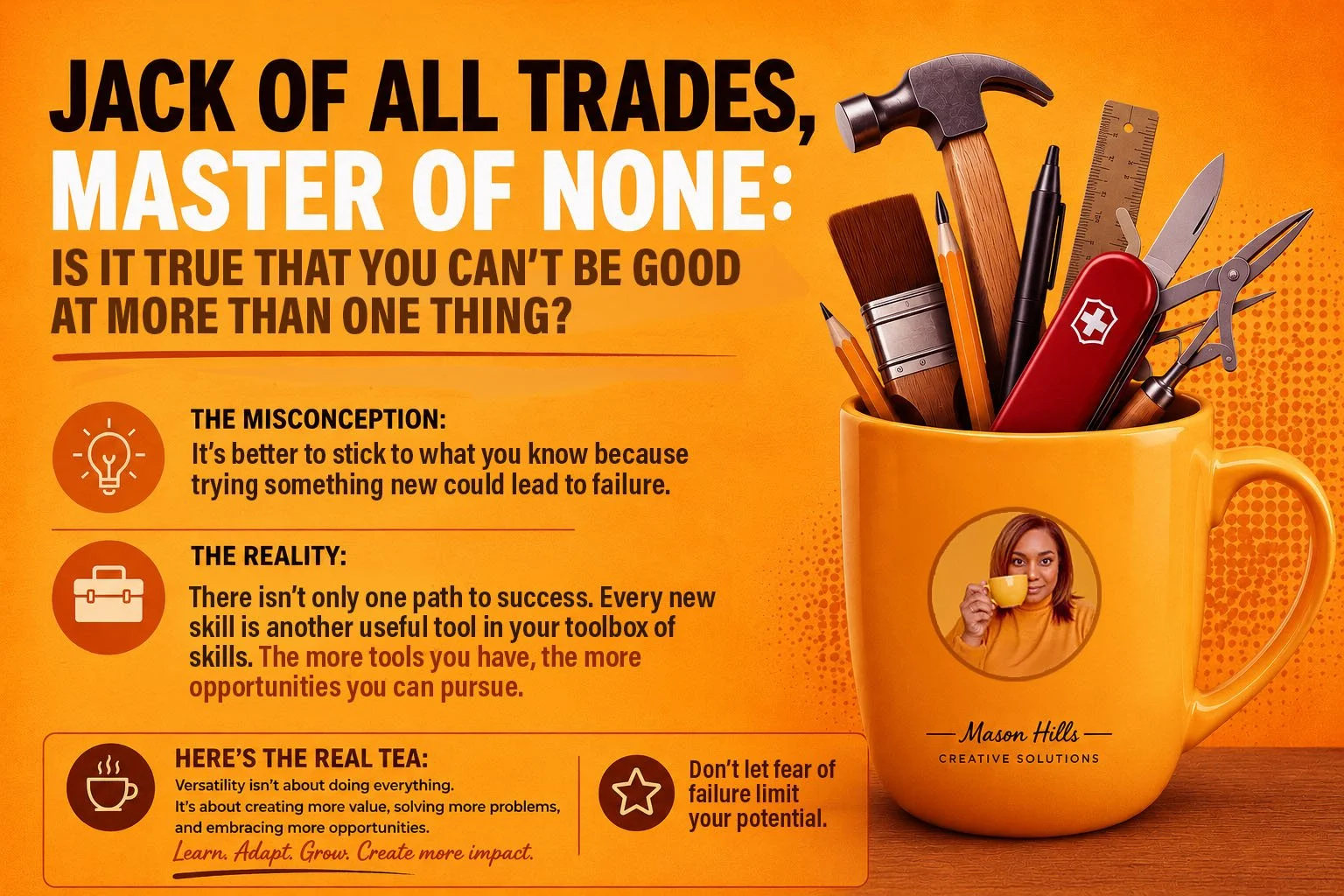
Graphic illustrating how learning new skills expands your opportunities, solves more problems, and makes you more valuable in today's evolving workplace.